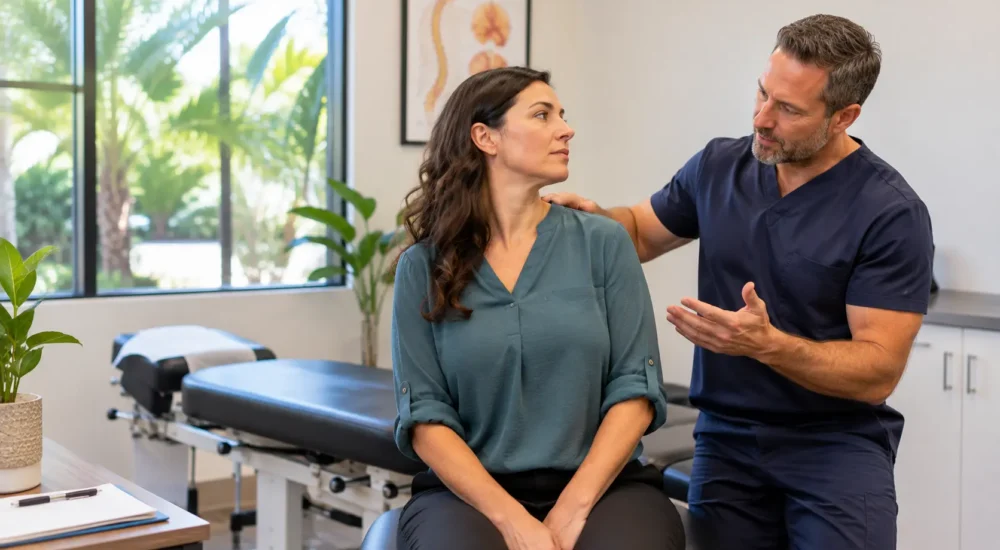
After a collision, most people feel shaken rather than injured. That experience is common and…
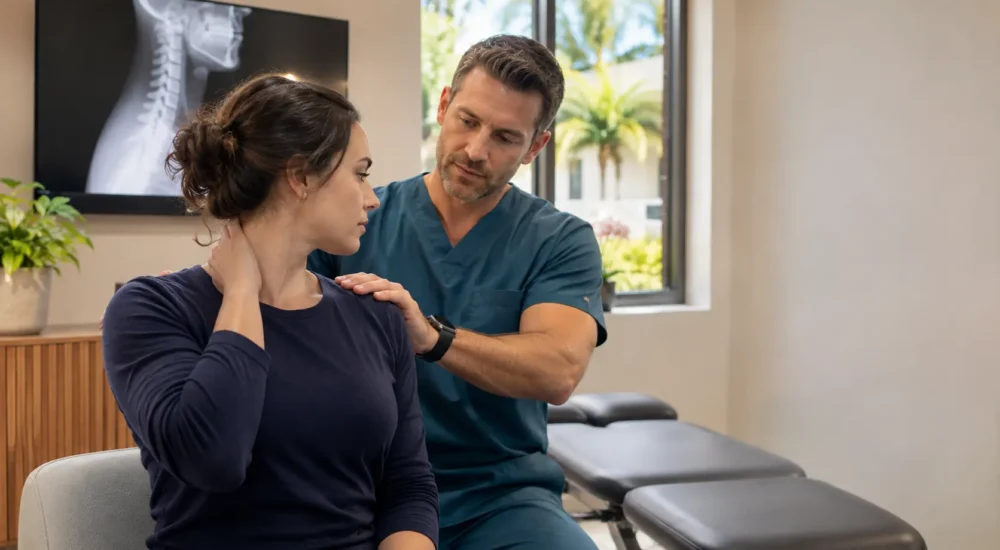
A Normal X-Ray After a Collision Doesn’t Mean Your Spine Is Fine
Bone shows up clearly on X-ray. Ligament damage, facet joint restriction, and soft tissue injury don’t, because X-ray isn’t designed to detect them. A clean scan after a collision is genuinely good news about fractures. It isn’t a complete picture of what happened to your spine, and treating it as one is where recoveries start going wrong.
Key Takeaways
- A normal X-ray rules out fracture, not spinal injury
- Pain that returns when medication wears off points to a structural problem medication can’t fix
- When care begins shapes what recovery is actually possible
- Chiropractic rehabilitation works at the mechanical source of symptoms, not just where the pain lands
- The weeks immediately after an injury are when the recovery window is most accessible
Why Does the Pain Keep Coming Back?
A collision forces your spine through a range of motion it wasn’t built to handle at that speed. Joints become restricted. Ligaments stretch past their functional range. The surrounding musculature contracts hard to protect structures that have become suddenly unstable. That’s not just inflammation. It’s a mechanical disruption: joints that can’t move freely, soft tissue locked in a sustained protective pattern, and nerves irritated by altered mechanics throughout the area.
Pain medication changes how all of that feels. It doesn’t change what’s generating the signal.
The pattern most accident patients experience is consistent. Medication provides a few hours of relief. Pain returns when it wears off. The working assumption becomes that more rest, or a stronger prescription, will eventually solve it. Neither one touches the joint restriction that’s producing the signal in the first place.
Rest can actually compound the problem. When an injured joint stops moving, the body begins depositing fibrous tissue around it as a protective response. That tissue is less flexible and less organized than healthy connective tissue. The joint heals into a reduced range of motion and carries that limitation forward. That isn’t recovery. That’s the injury becoming a permanent structural feature.
Managing symptoms isn’t the same as fixing what’s causing them. If that distinction matters to you, it’s worth understanding what the full range of services at Schnipper Chiropractic is built to address.
What Does Chiropractic Rehabilitation Actually Do?
A spinal adjustment is a controlled, specific force applied to a restricted joint to restore its normal movement pattern. When a joint is stuck, the musculature surrounding it can’t fully release because it’s compensating for the lost mobility. Once the joint moves freely, that compensation pattern has an opportunity to relax, and the tissue around it can begin healing rather than bracing indefinitely.
Consider what a typical post-accident presentation looks like in practice. Someone reports neck stiffness and a dull, persistent headache that developed a day or two after a rear-end collision. No fracture on imaging. Orthopedic examination reveals restricted mobility in the cervical spine and sustained muscular contraction along one side of the neck. The headache in a presentation like this often isn’t originating in the head at all. The more likely mechanical source is restricted facet joints and irritated soft tissue in the cervical spine, with pain referring upward. The site of the pain and the site of the problem are different places, which is why care that targets only where the pain is felt misses what’s generating it.
Addressing that presentation means restoring mobility to the restricted cervical segments first, then working the contracted surrounding tissue through soft tissue therapy, then progressively rebuilding the supporting musculature as the acute phase resolves. Each stage depends on the one before it. That’s why having spinal adjustment, soft tissue therapy, and rehabilitation services coordinated under one roof matters. The continuity between stages isn’t a convenience. It’s part of how the care works.
Starting Care Now vs. Waiting to See What Happens
The most consequential decision most accident patients make isn’t which office they call. It’s whether they start care while the recovery window is still open.
| Factor | Waiting to See If It Resolves | Starting Care with Schnipper Chiropractic |
|---|---|---|
| Joint restriction | Persists without intervention and tends to calcify into chronic limitation | Addressed directly through targeted spinal adjustment |
| Fibrous tissue formation | Accelerates as injured tissue stays immobile | Interrupted by restoring movement during the acute phase |
| Soft tissue injury | Heals incompletely, often with lasting reduction in flexibility | Treated alongside adjustments through coordinated soft tissue therapy |
| Symptom pattern | Dull pain sharpens, then becomes constant as compensation builds on itself | Improves as the mechanical source is corrected |
| Long-term function | Chronic instability and recurring pain cycles become more likely | Better structural outcome when injury is treated before patterns set |
| Recovery cost | Rises as more intensive care becomes necessary further down the road | Lower when treatment starts while the window is still open |
The weeks immediately after an injury are when that window is most accessible, before fibrous tissue matures and compensation patterns become habitual. The window closes whether care starts or not. Waiting is a choice, and it almost never turns out to be the less costly one once you account for the full length of a harder recovery.
Why Whiplash Gets Sent Home Without Treatment
Whiplash affects the cervical ligaments, the surrounding musculature, and the small facet joints between vertebrae. None of those structures appear clearly on standard imaging unless damage has reached fracture level. So the patient hears “nothing’s broken,” which is accurate, and goes home. The incomplete picture gets mistaken for a complete one.
What makes whiplash prone to becoming chronic comes down to how ligament tissue heals. Ligaments receive their blood supply indirectly, primarily through the synovial fluid in nearby joints and the vessels at their attachment points. Organized healing depends in part on proper mechanical loading through the joints those ligaments support. When a cervical ligament heals while the surrounding joint is stuck and immobile, the mechanical environment for that healing is disorganized. The result is often incomplete recovery, with recurring neck pain and instability that accumulates gradually over months rather than appearing all at once.
Intervening before that pattern sets changes what recovery looks like. Chiropractic care for whiplash addresses three connected problems: restoring mobility to restricted joints before fibrous tissue matures, reducing mechanical load on inflamed surrounding tissue, and progressively rebuilding the musculature as the acute phase resolves.
If you’re managing neck pain or headaches that developed after a collision, scheduling an evaluation gives you a structural picture that your pain level alone can’t provide.
Is It Safe to Begin Care Soon After a Collision?
Yes, with one qualification: the evaluation comes before the adjustment.
The first step in responsible post-accident care is ruling out contraindications. Fractures, dislocations, and certain types of acute ligamentous instability require a different care pathway entirely. A thorough clinical history and orthopedic examination identify those presentations before any manual therapy is considered. When a red flag is present, the appropriate referral comes first.
Once contraindications are cleared, chiropractic care is appropriate. The adjustments used in post-accident care are calibrated differently than those used for chronic conditions. Acutely inflamed tissue responds to gentler, more specific input. The goal is restoring movement without adding irritation to tissue that’s already reactive.
The risk of delaying care is higher than the risk of receiving it. Soft tissue injuries left unaddressed during the acute phase tend to become chronic conditions requiring longer, more intensive treatment, and they often plateau at a lower level of function than injuries treated early. You can learn more about the Schnipper Chiropractic team before your first visit.
What Falls Outside the Scope of Chiropractic Care
Fractures, dislocations, and injuries requiring surgical repair are outside what chiropractic care addresses. If you experienced a high-impact collision and you’re noticing rapidly worsening neurological symptoms including numbness spreading into an arm or leg, significant muscle weakness, or loss of bladder or bowel control, those require emergency evaluation before anything else.
Chiropractic care also doesn’t address the psychological dimension of recovering from a traumatic event. That’s a real part of the picture for many accident survivors, and it deserves its own support alongside structural care.
What chiropractic rehabilitation does address is the structural aftermath: restricted joints, damaged soft tissue, and the compensation patterns that develop when the body protects an injured area. For most people who walk away from a collision knowing something isn’t right without being able to name what, that’s precisely where the problem lives. You can review pricing information before your first appointment, and the front desk can answer questions about coverage and billing when you call.
Frequently Asked Questions
How soon after a car accident should I see a chiropractor?
As soon as possible once emergency injuries have been ruled out, ideally within the first week. The acute phase is when injured tissue is most responsive to care, and delaying allows fibrous tissue to organize around restricted structures. Starting early gives you the best structural foundation for a complete recovery.
Will car insurance cover chiropractic care after an accident?
Florida’s Personal Injury Protection coverage includes chiropractic care as part of accident-related medical treatment. Florida law generally requires that you seek care within 14 days of the accident for PIP coverage to apply, which is one more reason an early evaluation matters. The team at Schnipper Chiropractic can walk you through the billing process at your first visit.
What’s the difference between chiropractic care and physical therapy after a collision?
Chiropractic care focuses on restoring joint mobility and spinal alignment as the structural foundation of recovery. Physical therapy focuses on rebuilding functional strength and movement patterns. Both are often appropriate at different stages. Schnipper Chiropractic and Wellness Center integrates physical therapy into its post-accident rehabilitation approach, so those stages connect under one roof rather than requiring separate providers.
I don’t have much pain right now. Do I still need an evaluation?
Yes. The body’s acute stress response can suppress pain perception for hours or even a day or two after a collision. Whiplash injuries commonly don’t produce significant symptoms until well after the event. Absence of immediate pain isn’t a reliable indicator that nothing is injured, and a structural evaluation provides information your pain level alone can’t give you.
How many visits will I need?
That depends on the severity of the injury and how quickly care was started. A minor soft tissue injury treated promptly requires a different course of care than a more significant injury with delayed treatment. Your plan at Schnipper Chiropractic is built around your specific examination findings, not a generic protocol.
Can chiropractic care help with headaches that developed after the accident?
Post-traumatic headaches are frequently cervicogenic, meaning they originate from restricted or irritated structures in the cervical spine rather than from the head itself. Adjustments to the upper cervical spine, combined with soft tissue work on the surrounding musculature, address the mechanical source of those headaches rather than just the location where the pain is felt.
What if I tried chiropractic care before and it didn’t help?
Effectiveness depends heavily on accurate diagnosis and matching treatment to the actual structural findings. If a previous course of care didn’t produce results, the relevant questions are whether treatment targeted the real mechanical source, whether soft tissue therapy was included alongside adjustments, and whether the full clinical picture was properly assessed. A fresh evaluation can clarify whether a different approach would produce a different outcome.
Brian Schnipper, D.C. is the founder of Schnipper Chiropractic and Wellness Center and has spent 25 years helping patients in Royal Palm Beach, Wellington, and the surrounding communities recover from auto accident injuries, chronic pain, and musculoskeletal conditions through personalized, hands-on care. To schedule an evaluation, contact the office directly.

Related Posts