
A collision sets a structural process in motion that doesn't pause while you decide whether…

Why Car Accident Pain Shows Up Days Later (And What That Delay Is Costing You)
After a collision, most people feel shaken rather than injured. That experience is common and makes sense physiologically: the body’s emergency stress response temporarily mutes pain signals in the immediate aftermath of trauma. The structural damage to your spine, muscles, and ligaments can already be present before you notice a single symptom.
Key Takeaways
- Delayed pain after a car accident isn’t a sign you weren’t hurt; it’s a sign the body’s protective response is still active
- Soft tissue injuries and cervical joint dysfunction often go undetected at the ER because they don’t show on standard imaging
- Florida’s no-fault PIP insurance requires you to initiate treatment within 14 days of an accident or forfeit coverage
- Chiropractic care addresses the mechanical cause of post-accident pain, not just the sensation of it
- Scar tissue forms around unresolved structural problems when treatment is delayed, which turns an acute injury into a chronic one
Why Does the Pain Take Days to Arrive?
When your car absorbs an impact, your nervous system does something counterintuitive: it temporarily suppresses pain perception so you can respond to the threat. This isn’t a sign you weren’t hurt. It’s a survival mechanism. Your body prioritizes function over accurate damage reporting in the immediate window after trauma. Acute inflammation also begins forming around injured tissue right away, and in the early hours, that swelling provides a temporary cushioning effect around the injury site.
The practical result is familiar to anyone who’s been through this. You get out of the car, check yourself over, feel rattled but physically intact, and decline the ambulance. The structural disruption to your cervical spine, the microtears in your paraspinal muscles, the stress placed on your lumbar ligaments, all of it may already be present. You just can’t register it yet.
As the hormonal response clears, usually within a day or two, the pain signal arrives without that buffer. At that point, many people have already concluded they probably don’t need treatment. That conclusion is the most expensive mistake accident victims make.
What Is Whiplash and Why Does It Get Missed?
Whiplash is a cervical spine injury produced by rapid acceleration-deceleration force. In a fraction of a second, the neck hyperextends and then hyperflexes well beyond its normal range of motion, stressing the joints, muscles, ligaments, and discs of the cervical spine at the same time. It isn’t soreness. It’s a mechanical disruption to multiple interconnected structures.
The reason it gets dismissed so frequently is that soft tissue injury and joint dysfunction aren’t visible on a standard X-ray. Emergency rooms are equipped to identify fractures and internal injuries. They’re not set up to evaluate the joint mobility restrictions, muscle guarding patterns, and connective tissue damage that whiplash actually produces. A patient can leave an ER with a clean scan and a genuine cervical injury that will generate headaches, neck stiffness, and radiating upper back pain for months if the structural problem underneath it isn’t treated correctly.
Consider a typical presentation: someone in a rear-end collision feels stiff but manageable the night of the accident. Two days later, turning their head produces sharp pain. By the end of the first week, they’re dealing with persistent headaches originating at the base of the skull and a dull ache spreading into one shoulder. That pattern isn’t new damage appearing on a schedule. It’s the original injury becoming impossible to ignore as the body’s initial protective response winds down.
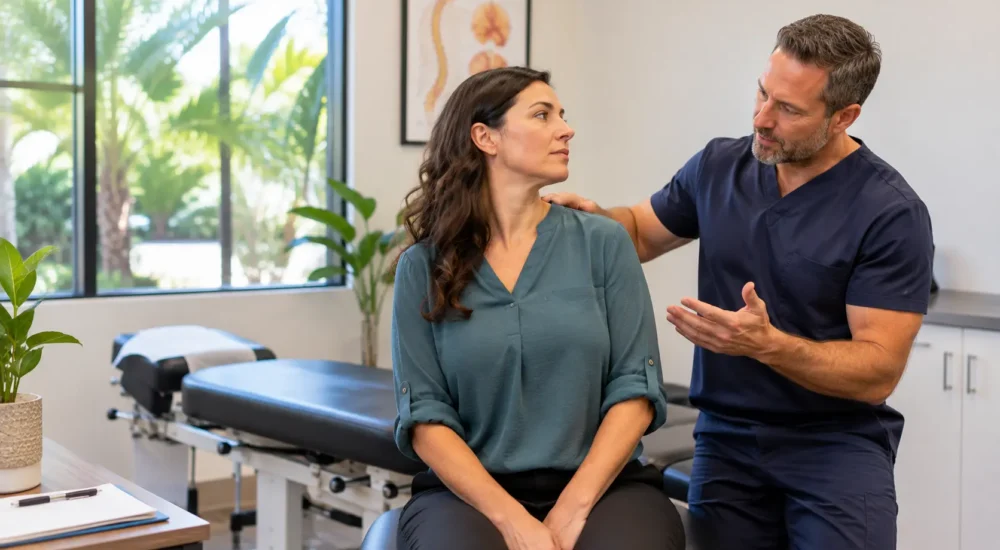
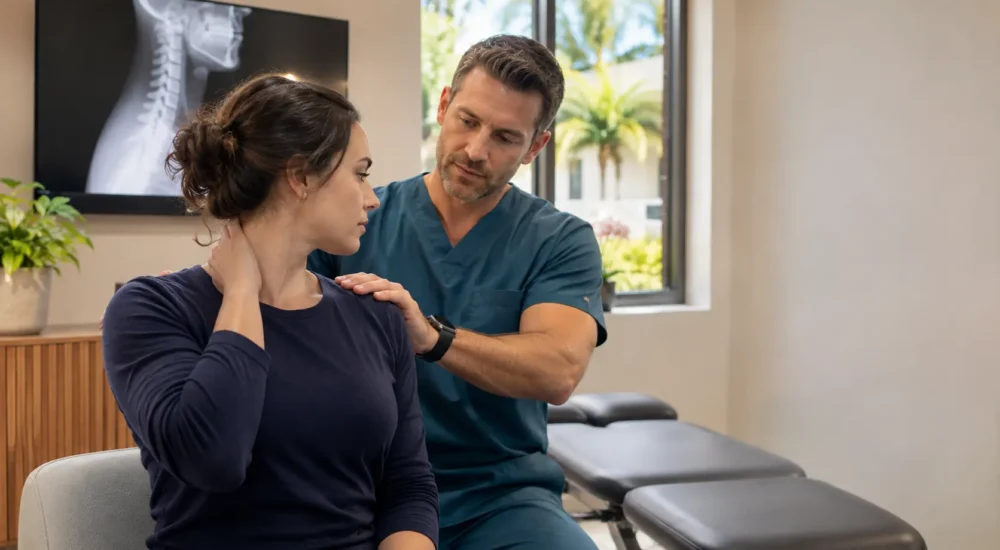
A chiropractic evaluation at Schnipper Chiropractic assesses what the ER wasn’t looking for: joint mobility, muscle guarding patterns, spinal alignment, and the neurological referral patterns that tell you which structures are actually involved.
How Chiropractic Treatment for Auto Injuries Works
The mechanism here is worth understanding because it explains why chiropractic care produces outcomes that rest and medication alone don’t.
A collision forces spinal joints into restricted or misaligned positions. When a joint loses its normal range of motion, the surrounding muscles don’t just hurt. They guard, contracting protectively around the dysfunctional segment to stabilize it. That guarding creates the stiffness, the limited rotation, and the referred pain patterns that accident patients describe for weeks afterward. Pain medication quiets the signal. It doesn’t change what’s generating it. Rest alone doesn’t restore joint mobility either.
Spinal adjustments restore proper movement to restricted joints. When the mechanical trigger is addressed, the muscular guarding response reduces because there’s no longer a structural problem driving it. Soft tissue therapy addresses the muscle and connective tissue damage that almost always accompanies joint dysfunction after a collision. For injuries with significant ligament or tendon involvement, shockwave therapy supports tissue repair in ways that passive treatment alone often can’t produce.
The full range of services available at Schnipper Chiropractic is built to address the complete picture of an auto injury, not just the symptom that brought you in.
Florida’s PIP Window: What You Need to Know Before You Wait
Florida operates under a no-fault auto insurance system. Every registered driver carries Personal Injury Protection coverage, and that coverage pays for medical treatment after an accident regardless of who caused the collision.
What many accident victims don’t discover until it’s too late is that Florida law requires you to initiate treatment within 14 days of the accident to access your PIP benefits. That deadline doesn’t accommodate a “wait and see” approach. If you miss it, your insurer has legal grounds to deny the claim. Your specific policy terms and coverage limits are worth confirming with your insurer or an attorney, since individual policies vary.
Chiropractic care qualifies as covered treatment under Florida PIP. Getting evaluated within that window protects both your physical recovery and your right to have care covered. If you have questions about costs and coverage, pricing and payment information is available, and flexible payment plans are offered for patients navigating the insurance process.
What a Structured Recovery Actually Looks Like
Post-accident recovery isn’t a single visit. It’s a phased process, and understanding those phases helps you recognize what meaningful progress looks like along the way.
The first phase addresses the acute injury directly. The priority is reducing inflammation, restoring joint mobility, and preventing scar tissue from forming in compromised positions. Spinal adjustments and soft tissue therapy are most critical during this window because the window itself is finite. Scar tissue doesn’t wait for you to feel ready.
Once the acute phase resolves, the focus shifts to rebuilding the strength and stability of the structures that were damaged. This is where progressive loading and rehabilitative movement come in. Skipping this phase is the reason many people feel significantly better for a few months and then relapse. The pain returns not because treatment failed, but because the underlying structural weakness was never fully addressed.
The third phase is maintenance, and it matters more than most patients expect. Injuries that weren’t fully rehabilitated create vulnerabilities that surface later as chronic pain. A maintenance plan keeps the spine properly aligned and the surrounding tissue functional long after the acute episode is resolved. Pain that returns on a schedule isn’t a healing problem. It’s a structural one that never finished healing.
Comparing Your Options After a Collision
| Approach | What It Addresses | What It Leaves Unresolved | Long-Term Outlook |
|---|---|---|---|
| Waiting, doing nothing | Nothing actively | Joint dysfunction, scar tissue, soft tissue damage | High likelihood of chronic pain pattern |
| ER visit only | Fractures, internal injuries | Soft tissue damage, spinal misalignment, joint mobility | Injury often undocumented and structurally untreated |
| Rest and over-the-counter medication | Temporary symptom relief | Mechanical cause of pain | Frequent relapse, progressive stiffness |
| Chiropractic care with soft tissue therapy | Joint mobility, muscle guarding, connective tissue repair | Acute fractures requiring surgical evaluation | Structural cause addressed, lower relapse risk |
| Chiropractic combined with shockwave and physical therapy | Joint function, tissue repair, and functional strength | Nothing in the standard auto injury category | Best position for long-term function restoration |
The comparison that matters most isn’t cost. It’s what each approach actually resolves versus what it leaves to compound over time.
Who Benefits Most from Post-Accident Chiropractic Care
Chiropractic care is most effective for the injuries that account for the majority of auto accident cases: soft tissue damage, joint dysfunction, whiplash, and spinal misalignment. For acute fractures, internal organ injuries, or neurological emergencies, emergency medical care comes first, full stop. Once those are cleared, chiropractic care is frequently the appropriate next step.
It’s also worth being straightforward about timelines. Moderate whiplash and soft tissue injuries can show meaningful improvement with consistent treatment, but more complex injuries, or those that weren’t addressed quickly, take longer to resolve. There are no shortcuts in that part of the process.
The team at Schnipper Chiropractic and Wellness Center has been treating auto accident patients throughout Royal Palm Beach and the surrounding communities for 25 years. Their evaluation process is built to identify what’s structurally wrong, not just to confirm what you already suspect.
Frequently Asked Questions
How soon after a car accident should I see a chiropractor?
As soon as possible. Florida’s PIP insurance sets a legal threshold for initiating treatment, but the clinical case for acting quickly is independent of that deadline. The sooner joint dysfunction and soft tissue damage are assessed and addressed, the less scar tissue has the opportunity to form in compromised positions, and the more complete recovery tends to be.
Will my car insurance cover chiropractic treatment after an accident?
Florida’s PIP coverage includes chiropractic care as a covered treatment for auto accident injuries, provided you initiate care within the statutory treatment window. Your specific policy terms and benefit limits are worth confirming with your insurer, but most accident victims in Florida can access chiropractic treatment through their PIP coverage without significant upfront out-of-pocket costs.
I don’t have much pain right now. Do I still need to be evaluated?
Yes. The absence of immediate pain after a collision doesn’t confirm you’re uninjured. Because the body’s stress response temporarily suppresses pain perception in the hours following an accident, an evaluation shortly after the collision documents your condition and identifies structural issues before they develop into a chronic pattern.
What’s the difference between going to the ER and seeing a chiropractor after an accident?
The ER is the right place for fractures, head trauma, and internal injuries. It isn’t set up to assess soft tissue damage, cervical joint dysfunction, or the mechanical problems that produce most post-accident pain. A chiropractic evaluation after ER clearance addresses what the ER wasn’t designed to look for.
How long does post-accident treatment typically take?
Treatment length depends on injury severity and how quickly care was initiated. Moderate whiplash and soft tissue injuries progress through the acute phase with consistent care, but more complex injuries, or those that went untreated for a period after the accident, take longer. Your plan at Schnipper Chiropractic is built around your specific injury pattern, not a fixed visit count.
Can chiropractic care help with headaches after a car accident?
Post-accident headaches frequently originate from joint and muscle dysfunction in the cervical spine rather than from the head itself. Chiropractic adjustments that restore normal joint mobility in the neck address this mechanical source directly, which is why many patients find their headache pattern improves as their cervical alignment is restored.
What if the collision seemed minor? Is an evaluation still necessary?
Low-speed impacts can still produce significant soft tissue and joint injuries, particularly in the cervical spine. The force required to stress cervical ligaments and disrupt joint mechanics is lower than most people assume. Any neck stiffness, headache, or back discomfort following a collision, regardless of how minor the impact appeared, is worth getting evaluated before the treatment window closes.
If you’ve been in an accident and you’re in the greater West Palm Beach area, contact Schnipper Chiropractic to schedule your evaluation at the Royal Palm Beach location (1011 N. State Road 7, Suite D) or the Wellington office (129 S. State Road 7, Suite 402). The 14-day clock starts at the moment of impact, not when the pain finally becomes impossible to ignore.
About the Author: Brian Schnipper, D.C. is the founder and lead chiropractor at Schnipper Chiropractic and Wellness Center. His focus is on identifying the structural causes of pain and building individualized care plans that address them directly, from spinal adjustments and soft tissue therapy to auto accident injury recovery and rehabilitation. The practice’s new Palm Beach County location is now open at 7070 Seminole Pratt Whitney Rd., Suite #9, Loxahatchee, FL 33470.

Related Posts
Comments (0)